Life: A Cento Poem by Mrs. H. A. Deming, 1868, with Researched Quotation Sources
Years ago I came across the below poem in Literary Frivolities, Fancies, Follies, and Frolics (Dobson, 1880) in the "Centones or Mosaics" section. I've yet to find the original poem publication, but this cento is said to have been first published in 1868 in The Times or the Daily Times of San Francisco, composed by Mrs. H. A. Deming. It is also said to have taken her one year to find and fit all the pieces together.
The poem was titled "LIFE" but the section heading often printed above her cento was "A Literary Curiosity." According to The Viral Texts Project, this was one of the most widely reprinted poems in nineteenth century newspapers; thus far, they have found it in 224 newspapers, dating back to March 1868.
Recently I worked with Kimberly Sharp, a bibliophile from Southern California, trying to determine the identity of this mysterious Mrs. Deming, as there seemed to be no information about her on the Web or anywhere else that we could find. After rooting around in the depths of the interwebs and libraries, we think that this cento was composed by Elizabeth P. Deming (1834–1892), wife of Horace A. Deming (1833–1911), who spent much of his working life as a representative for sewing machine and clothing pattern companies. We found no mention of a paid profession for Elizabeth, so the assumption is that she was a housewife. She was born in Maine and Horace in Vermont. At the time of the cento's publication they resided in San Francisco, and they remained Californians for the remainder of their lives. They had one child, Helen Deming (1869–1933), but no grandchildren that I can determine.
Ms. Sharp also discovered that Mrs. Deming had a poem of her own published a year after the cento, in 1869. It is titled "Look to the End" and a reprinted version is available to read online for free at the California Digital Newspaper Collection, Center for Bibliographic Studies and Research, University of California, Riverside.
It's taken some doing, but I've uncovered the original literary work for all of the thirty-eight quotations used in Mrs. Deming's cento, listed in detail below the poem. I've also included larger extracts, for context and to get a feel for each author's style. The original poems span the late sixteenth century to the mid-nineteenth century, so it's a pleasing variety of literary antiquities. The biggest surprise was finding that one of the lines [13] is from an erotic poem. The funniest find was that an author quoted for a lovely poem about the passage of time [33] also had, in the same book, some medical poems describing the urine of patients with various diseases. The biggest disappointment — or, from my quotation anthologist point of view, the most exciting discovery — was finding that Deming misattributed one of the authors [31]. Another line [2] is almost certainly misattributed but that one wasn't her fault. Sources and acknowledgements for the biographical and literary research are listed at the bottom of this page.
—tg
L I F E .
1 Why all this toil for triumphs of an hour?2 Life's a short summer, man a flower; 3 By turns we catch the vital breath and die—4 The cradle and the tomb, alas, so nigh. 5 To be is better far than not to be,6 Though all man's life may seem a tragedy; 7 But light cares speak when mighty griefs are dumb,8 The bottom is but shallow whence they come. 9 Your fate is but the common fate of all;10 Unmingled joys, here, to no man befall, 11 Nature to each allots his proper sphere,12 Fortune makes folly her peculiar care; 13 Custom does not often reason overrule,14 And throw a cruel sunshine on a fool. 15 Live well, how long or short permit to heaven.16 They who forgive most, shall be most forgiven. 17 Sin may be clasped so close we cannot see its face—18 Vile intercourse where virtue has no place; 19 Then keep each passion down, however dear,20 Thou pendulum, betwixt a smile and tear; 21 Her sensual snares, let faithless pleasures lay,22 With craft and skill, to ruin and betray; 23 Soar not too high to fall, but stoop to rise,24 We masters grow of all that we despise. 25 O, then, renounce that impious self-esteem;26 Riches have wings, and grandeur is a dream. 27 Think not ambition wise because 'tis brave,28 The paths of glory lead but to the grave. 29 What is ambition?—'tis a glorious cheat!—30 Only destructive to the brave and great. 31 What's all the gaudy glitter of a crown?32 The way to bliss lies not on beds of down. 33 How long we live, not years, but actions, tell;34 That man lives twice who lives the first life well. 35 Make, then, while yet we may, your God your friend,36 Whom Christians worship, yet not comprehend. 37 The trust that's given guard; and to yourself be just;38 For, live we how we can, yet die we must.
Authors Quoted —
1 Edward Young; 2 John Hawkesworth*; 3 Alexander Pope; 4 Matthew Prior; 5 George Sewell; 6 Edmund Spenser; 7 Samuel Daniel; 8 WalterRaleigh†; 9 Henry Wadsworth Longfellow; 10 Robert Southwell; 11 William Congreve; 12 Charles Churchill; 13 John Wilmot; 14 John Armstrong; 15 John Milton; 16 Philip James Bailey; 17 Richard Chenevix Trench; 18 William Somerville; 19 James Thomson; 20 Lord Byron; 21 Tobias Smollett; 22 George Crabbe; 23 Philip Massinger; 24 Abraham Cowley; 25 James Beattie; 26 William Cowper; 27 William D'Avenant; 28 Thomas Gray; 29 Nathaniel Parker Willis; 30 Joseph Addison; 31 Henry Brooke‡; 32 Francis Quarles; 33 Rowland Watkyns; 34 Robert Herrick; 35 William Mason; 36 Aaron Hill; 37 Richard Henry Dana; 38 William Shakespeare
LINE 1 — E. YOUNG, NIGHT THOUGHTS, 1740s
The world's a stately bark, on dang'rous seas,
With pleasure seen, but boarded at our peril:
Here, on a single plank, thrown safe ashore,
I hear the tumult of the distant throng,
As that of seas remote, or dying storms;
And meditate on scenes more silent still;
Pursue my theme, and fight the fear of Death.
Here, like a shepherd gazing from his hut,
Touching his reed, or leaning on his staff,
Eager Ambition's fiery chace I see;
I see the circling hunt of noisy men
Burst law's inclosure, leap the mounds of right,
Pursuing, and pursu'd, each other's prey;
As wolves, for rapine; as the fox, for wiles;
Till Death, that mighty hunter, earths them all.
Why all this toil for triumphs of an hour? ←
What tho' we wade in wealth, or soar in fame?
Earth's highest station ends in, "Here he lyes:"
And "dust to dust" concludes her noblest song.
If this song lives, posterity shall know
One, tho' in Britain born, with courtiers bred,
Who thought ev'n gold might come a day too late;
Nor on his subtle deathbed plann'd his scheme
For future vacancies in church or state;
Some avocation deeming it—to die;
Unbit by rage canine of dying rich;
Guilt's blunder! and the loudest laugh of hell.
—Edward Young (c.1683–1765), English author, The Complaint: or, Night-Thoughts on Life, Death, and Immortality, 1742–1745, quoted from a 1770 edition
LINE 2 — J. HAWKESWORTH*, WINTER, 1740s
No more the Morn, with tepid rays,
Unfolds the flow'r of various hue, Noon spreads no more the genial blaze,
Nor gentle Eve distills the dew:
The ling'ring hours prolong the night,
Usurping Darkness shares the day, Her mists restrain the force of light,
And Phœbus holds a doubtful sway:
By gloomy twilight half-reveal'd,
With sighs we view the hoary hill,
The leafless wood, the naked field,
The snow-topt cott, the frozen rill.
No music warbles thro' the grove,
No vivid colours paint the plain,
No more with devious steps I rove
Thro' verdant paths now sought in vain!
Aloud the driving tempest roars,
Congeal'd, impetuous show'rs descend,
Haste, close the window, bar the doors,
Fate leaves me Stella, and a friend.
In Nature's aid let Art supply
With light and heat, my little sphere,
Rouze, rouze the fire, and pile it high,
Light up a constellation here.
Let Music sound, the voice of joy!
Or Mirth repeat the jocund tale;
Let Love his wanton wiles employ,
And o'er the season wine prevail,
Yet Time, Life's dreary winter brings,
When Mirth's gay tale shall please no more,
Nor Music charm, tho' Stella sings,
Nor Love nor Wine the spring restore:
Catch then, O! catch the transient hour,
Improve each moment as it flies,
Life's a short summer, man a flow'r, ←
He dies! alas! how soon he dies!
—Anonymous, "WINTER. An ODE," in The Gentleman's Magazine, December 1747, *said to be written by John Hawkesworth (c.1715–1773), per "Crito" (John Duncombe, 1729–1786), contributor to forenamed magazine [Mrs. Deming attributed Samuel Johnson (1709–1784) for this line, but at the time it was thought by many to be his poem. It's even in some collections of Johnson's poems, but all posthumous, beginning in 1785. Originally this poem was published without attribution, in the magazine and issue cited above. It started being attributed to Dr. Johnson in 1770, during his lifetime, in others' anthologies. From what I've read there were so many editorial shenanigans going on both during his life and afterwards, the history of the poem's publications and attributions is a bit messy. Even after reading everything I could find from the 1700s up to modern day, it seems there is still no definitive answer on who the author is. Much evidence points to Hawkesworth, but there is also a tiny chance that Johnson either authored it or somehow had a hand in it. It could also have been by a different anonymous author. Even James Boswell apparently cannot be counted on as a trustworthy source in this matter; he claimed that the poem must have been Johnson's, but then again, apparently Boswell did not like Hawkesworth. Scholars (the debate was going by 1779, and the historical trail of attributions is still being written about to this very day) all seem to agree that Johnson wasn't the author. Most experts quite confidently point to Hawkesworth, but it is an attribution that likely we will never be able to cite with absolute certainty, as we have neither testimony nor manuscript from either supposed author. —tg]
LINE 3 — A. POPE, ESSAY ON MAN, 1730s
Here then we rest: "The Universal Cause
"Acts to one end, but acts by various laws."
In all the madness of superfluous health,
The trim of pride, the impudence of wealth,
Let this great truth be present night and day;
But most be present, if we preach or pray.
Look round our World; behold the chain of Love
Combining all below and all above.
See plastic Nature working to this end,
The single atoms each to other tend,
Attract, attracted to, the next in place
Form'd and impell'd its neighbour to embrace.
See Matter next, with various life endu'd,
Press to one centre still, the gen'ral Good.
See dying vegetables life sustain,
See life dissolving vegetate again:
All forms that perish other forms supply,
(By turns we catch the vital breath, and die) ←
Like bubbles on the sea of Matter born,
They rise, they break, and to that sea return.
Nothing is foreign; Parts relate to whole;
One all-extending, all-preserving Soul
Connects each being, greatest with the least;
Made Beast in aid of Man, and Man of Beast;
All serv'd, all serving: nothing stands alone!
The chain holds on, and where it ends, unknown.
—Alexander Pope (1688–1744), English author, An Essay on Man, 1733–1734, quoted from a 1755 edition [Epistle III]
LINE 4 — M. PRIOR, SOLOMON, 1718
Yet tell Me, frighted Reason! what is Death?
Blood only stopp'd, and interrupted Breath?
The utmost Limit of a narrow Span,
And End of Motion which with Life began?
As Smoke that rises from the kindling Fires
Is seen this Moment, and the next expires:
As empty Clouds by rising Winds are tost,
Their fleeting Forms scarce sooner found than lost:
So vanishes our State: so pass our Days:
So Life but opens now, and now decays:
The Cradle and the Tomb, alas! so nigh; ←
To live is scarce distinguish'd from to dye.
—Matthew Prior (1664–1721), English poet, Solomon on the Vanity of the World: A Poem in Three Books, 1718, quoted from a 1725 edition [Third Book: Power]
LINE 5 — G. SEWELL, SIR WALTER RALEIGH, 1719
Think not I hold that vain Philosophy
Of proud Indifference, that pretends to look
On Pain and Pleasure with an equal Eye.
To Be, is better far than Not to Be, ←
Else Nature cheated us in our Formation.
And when we are, the sweet Delusion wears
Such various Charms and Prospects of Delight,
That what we could not Will, we make our Choice,
Desirous to prolong the Life she gave.
Mad-men, and Fools may hurry o'er the Scene,
The wise Man walks an easy, sober Pace;
And tho' he sees one Precipice for all,
Declines the fatal Brink, oft looking back
On what he leaves, and thinking where he falls.
—George Sewell (c.1687–1726), English physician, The Tragedy of Sir Walter Raleigh, as it is Acted at the Theatre in Lincolns-Inn-Fields, 1719, quoted from the second edition [Act III, Scene IV, Sir Walter Raleigh speaking]
LINE 6 — E. SPENSER, TEARS OF THE MUSES, 1591
Who shall pour into my swollen eyes
A sea of tears that never may be dride,
A brasen voice that may with shrilling cryes
Pierce the dull heavens, and fill the air wide,
And Iron sides that sighing may endure
To wail the wretchedness of world impure?
Ah! wretched world, the den of wickedness,
Deform'd with filth and foul iniquity;
Ah! wretched world, the house of heaviness,
Fill'd with the wreaks of mortal misery;
Ah! wretched world, and all that is therein,
The vassals of Gods wrath, and slaves of sin.
Most miserable creature under sky,
Man without understanding doth appear;
For all this worlds affliction he thereby,
And Fortunes freaks is wisely taught to bear:
Of wretched life the only joy she is,
And th' only comfort in calamities.
She arms the breast with constant patience,
Against the bitter throes of dolours darts,
She solaceth with rules of Sapience
The gentle minds, in midst of worldly smarts:
When he is sad, she seeks to make him mery,
And doth refresh his sprights when they be weary.
But he that is of reasons skill bereft,
And wants the staff of wisdom him to stay,
Is like a ship, in midst of tempest left,
Withouten helm or Pilot her to sway,
Full sad and dreadful is that ships event:
So is the man that wants intendiment.
Why then do foolish men so much despise
The precious store of this celestial riches?
Why do they banish us, that patronize
The name of learning? Most unhappy wretches,
The which lie drowned in deep wretchedness,
Yet do not see their own unhappiness.
My part it is, and my professed skill,
The Stage with Tragick buskins to adorn,
And fill the Scene with plaints and out-cries shrill
Of wretched persons, to misfortune born:
But none more tragick matter I can find
Than this, of men depriv'd of sense and mind.
For all mans life meseems a Tragedy, ←
Full of sad sights and sore Catastrophees;
First coming to the world with weeping eye,
Where all his days, like dolorous Trophees,
Are heapt with spoils of fortune and of fear,
And he at last laid forth on baleful bear.
—Edmund Spenser (c.1552–1599), English poet, The Teares of the Muses, 1591, quoted from a 1678 edition, excepting the title which is the original spelling [Melpomene]
LINE 7 — S. DANIEL, COMPLAINT OF ROSAMOND, 1592
Amaz'd he stands, nor Voice nor Body stirs;
Words had no passage, Tears no issue found,
For Sorrow shut up Words, Wrath kept in Tears;
Confus'd Effects each other do confound;
Opprest with Grief, his Passions had no bound.
Striving to tell his Woes, Words would not come;
For light Cares speak, when mighty Griefs are dumb. ←
—Samuel Daniel (c.1562–1619), English author, The Complaint of Rosamond, 1592, quoted from a 1718 edition
LINE 8 — W. RALEIGH (ATTRIB.), SILENT LOVER
Passions are likened best to floods and streams:
The shallow murmur, but the deep are dumb;
So, when affections yield discourse, it seems
The bottom is but shallow whence they come. ←
They that are rich in words, in words discover
That they are poor in that which makes a lover.
—Sir Walter Raleigh (c.1554–1618), attributed, "The Silent Lover," quoted from The Poems of Sir Walter Raleigh, Collected and Authenticated with Those of Sir Henry Wotton and Other Courtly Poets from 1540 to 1650, edited by J. Hannah, 1875 [†It has been debated whether Raleigh is the author. —tg]
LINE 9 — H. W. LONGFELLOW, RAINY DAY, 1800s
The day is cold, and dark, and dreary;
It rains, and the wind is never weary;
The vine still clings to the mouldering wall,
But at every gust the dead leaves fall,
And the day is dark and dreary.
My life is cold, and dark, and dreary;
It rains, and the wind is never weary;
My thoughts still cling to the mouldering Past,
But the hopes of youth fall thick in the blast,
And the days are dark and dreary.
Be still, sad heart! and cease repining;
Behind the clouds is the sun still shining;
Thy fate is the common fate of all, ←
Into each life some rain must fall,
Some days must be dark and dreary.
—Henry Wadsworth Longfellow (1807–1882), American poet, "The Rainy Day," Ballads and Other Poems, 1842, quoted from an 1855 edition
LINE 10 — R. SOUTHWELL, TIMES GO BY TURNS, 1500s
The lopped tree in time may grow again;
Most naked plants renew both fruit and flower;
The sorriest wight may find release of pain,
The dryest soil suck in some moistening shower:
Times go by turns, and chances change by course,
From foul to fair, from better hap to worse.
The sea of fortune doth not ever flow,
She draws her favours to the lowest ebb;
Her tides have equal times to come and go,
Her loom doth weave the fine and coarsest web:
No joy so great, but runneth to an end;
No hap so hard, but may in fine amend.
Not always fall of leaf, nor ever spring,
No endless night, nor yet eternal day:
The saddest birds a season find to sing,
The roughest storm a calm may soon allay.
Thus with succeeding turns God tempereth all,
That man may hope to rise, yet fear to fall.
A chance may win that by mischance was lost,
That net that holds no great, takes little fish;
In some things all, in all things none are crossed;
Few all they need, but none have all they wish;
Unmingled joys here to no man befall: ←
Who least, hath some, who most, hath never all.
—Robert Southwell (1561–1595), English poet and martyr, "Tymes Goe By Turnes," quoted from an 1836 edition, excepting the title which is the original spelling
LINE 11 — W. CONGREVE, OF PLEASING, 1710
'Tis strange, dear Temple, how it comes to pass,
That no one Man is pleas'd with what he has.
So Horace sings — and sure, as strange as this:
That no one Man's displeas'd with what he is.
The Foolish, Ugly, Dull, Impertinent,
Are with their Persons and their Parts content.
Nor is that all; so odd a thing is Man,
He most would be what least he should or can...
Nature, to each allots his proper Sphere, ←
But, that forsaken, we like Comets err:
Toss'd thro' the Void, by some rude Shock we're broke,
And all our boasted Fire is lost in Smoke.
Next to obtaining Wealth, or Pow'r, or Ease,
Men most affect, in general to please:
Of this Affection, Vanity's the Source,
And Vanity alone obstructs its Course;
That Telescope of Fools, thro' which they spy
Merit remote, and think the Object nigh.
The Glass remov'd, would each himself survey,
And in just Scales, his Strength and Weakness weigh,
Pursue the Path for which he was design'd,
And to his proper Force adapt his Mind;
Scarce one, but, to some Merit might pretend,
Perhaps might please, at least would not offend.
Who would reprove us while he makes us laugh,
Must be no Bavius, but a Bickerstaffe.
If Garth, or Blackmore, friendly Potions give,
We bid the dying Patient drink and live:
When Murus comes, we cry, beware the Pill,
And with the Tradesman were a Tradesman still.
If Addison, or Rowe, or Prior write,
We study 'em with Profit and Delight:
But when vile Macer and Mundungus rhyme,
We grieve we've learnt to read, ay, curse the Time,
All Rules of Pleasing in this one unite, Affect not any thing in Nature's spight.
Baboons and Apes ridiculous we fine;
For what? For ill resembling Human-kind, None are, for being what they are, in fault,
But for not being what they wou'd be thought.
—William Congreve (1670–1729), English dramatist, "Of Pleasing; an Epistle to Sir Richard Temple," Poems upon Several Occasions, 1710
LINE 12 — C. CHURCHILL, ROSCIAD, 1761
What then could tempt thee, in a critic age,
Such blooming hopes to forfeit on a stage?
Could it be worth thy wond'rous waste of pains?
To publish to the world thy lack of brains?
Or might not reason, e'en to thee, have shewn
Thy greatest praise had been to live UNKNOWN?
Yet let not vanity, like thine, despair:
Fortune makes Folly her peculiar care. ←
—Charles Churchill (1731–1764), English poet, "The Rosciad," 1761, quoted from a 1763 edition
LINE 13 — J. WILMOT, THE PERFECT ENJOYMENT, 1600s
Since now my Sylvia is as kind as fair,
Let endless Joy succeed a long Despair.
Oh what a night of Pleasure was the last!
A full Reward for all my Troubles past:
And on my Head if future mischiefs fall,
This happy Night will make amends for all.
Nay tho' my Sylvia's love should turn to hate,
I'de think on this, and dying kiss my fate.
Twelve was the lucky minute when we met,
And on her bed were close together set:
Tho' listning Spies might be perhaps too near,
Love fill'd our Hearts, there was no room for fear.
And whilst I strove her melting heart to move,
With all the powerful Eloquence of Love,
In her fair Face I saw the colour rise,
And an unusual softness in her Eyes:
Gently they look, and I with joy adore
That only Charm they never had before.
What she forbids, Love doth by signs command,
Languishing Looks and squeezing of the Hand,
Love's Cypher is not hard to understand:
Whilst I transported too with amorous rage,
And fierce with expectation to engage:
But fast she holds her Hands, and close her Thighs,
And what she longs to do, with Frowns denies.
A strange Effect in foolish Woman wrought,
Bred in Disguises, and by Custom taught:
Custom, which often Wisdom over-rules, ←
And onely serves for Reason to the Fools.
Taught by this method of her foolish Sex,
She's forc'd a while me and her self to vex:
But when at length we had been striving long,
Her Limbs grown weak, and her desires strong,
Who then can hold to let the Hero in,
When he assaults, and Love betrays within?
At last her hand to hide her blushes leave
The Fort ungarded, willing to receive
My fierce assault, mad with a Lovers hast,
Like Lightning, piercing and as quickly past:
Some little pain might check her kind desire,
But not enough to make her once retire:
Maids wounds for pleasure bear, as Men for praise,
Here Honour heals, there Love the smart allays.
Now she her well-contented thoughts employs,
On her past Fears and on her present Joys,
Whose Harbinger did freely all remove
To make fit room for great luxurious Love:
Fond of the welcome Guest, her Arms embrace
My Body, and her hand a better place:
Which with one touch so pleasing proud did grow,
It swell'd beyond the grasp that made it so.
Confinement scorns in any closer walls
Than those of Love, where it contended falls.
Tho' twice o'rethrown it more enflam'd does rise,
And will to the last drop fight out Loves prize.
She like some Amazon in Story proves,
That overcomes the Hero who she loves.
In the close strifes he took so much delight,
She then would think on nothing but the fight.
With joy she laid me panting at her feet,
But with more joy does his recovery meet:
Her trembling hand first gently rais'd his head,
She almost dies for fear lest he is dead:
Then does support him with a busie hand,
And with that Balm enables him to stand:
Till by her Charms she conquers him once more,
And wounds him deeper than she did before:
Now faln from the top of pleasure's hill,
With longing Eyes we look up thither still;
Still thither our unwearied wishes tend,
Till we that height of happiness ascend;
By gentle steps th' ascent it self exceeds
All Joys but that alone to which it leads.
First then so long and lovingly we kiss,
As if like Doves we knew no other bliss:
Still in one mouth our tongues together play,
Whilst groping hands are pleas'd no less than they.
Thus cling'd together now awhile we rest,
Breathing our Souls into each others breast:
Then give a general kiss of all our parts,
Whilst this blest way we make exchange of hearts.
Here would my praise as well as pleasure dwell,
Injoyments felt I scarcely like so well:
What little this comes short of rage and strength
Is largely recompenc'd with endless length.
This is a Joy if we could last and stay,
But Love's too eager to admit delay,
And hurries us along so smooth a way.
Now wanton with Delight we nimbly move
Our pliant Limbs in all the shapes of Love:
Our motion's not like those of idle fools,
Whose active Bodies shew their heavy Souls,
But sports of Love in which the willing mind
Makes us as able as our Souls are kind:
At length all languishing and out of breath,
Panting as in the agonies of Death
We lie entranc't, till one provoking kiss
Transports our ravisht Souls to Paradise.
Oh heaven of Love! thou moment of Delight!
Wrong'd by my words, my fancy does thee right.
Methinks I lie all melting in her Charms,
And fast lockt up within her Legs and Arms.
Bent are our minds, and all our thoughts on fire,
Still striving in the pangs of hot desire;
At once like Misers wallowing in their store
Of full possession yet desiring more.
Thus with repeated pleasures do we wast
Our happy hours, which like short minutes past.
To such a sum of Bliss our Joys amount,
The number now becomes too great to count;
And Nature now denying farther force,
From Deeds (alas) we fall into Discourse:
A fall which each of us in vain bemoans,
A greater fall than that of Kings from Thrones.
The tyde of pleasure flowing now no more,
We lie like Fishes gasping on the shore.
And now as after fighting wounds appear,
Which we in heat did neither feel nor fear,
She for my sake intreats me to give o'er,
And yet confest she'd gladly suffer more.
Her words are coy, while all her motions woo;
And when she askt if that it pleas'd me too,
I rag'd to shew how well, but could not do.
Thus does fond Man run himself out of breath,
And seeking rest would find it soon in death,
Did not kind Nature with a double force,
Restrain its strength and stop its headlong course.
Indulgently serve she well does spare,
This Child for hers that most deserves her care.
—John Wilmot, 2nd earl of Rochester (1647–1680), English poet, "The Perfect Enjoyment," quoted from Poems on Affairs of State: from The Time of Oliver Cromwell, to the Abdication of K. James the Second. Written by the greatest Wits of the Age. With some Miscellany Poems by the same: Most whereof never before Printed. Now carefully examined with the Originals, and Published without any Castration, The Third Edition, Corrected and much Enlarged, 1699 [Wow, definitely was not expecting to find erotica in researching this cento! —tg]
LINE 14 — J. ARMSTRONG, ART OF PRESERVING HEALTH, 1744
Virtue, the strength and beauty of the soul,
Is the best gift of heaven: a happiness
That even above the smiles and frowns of fate
Exalts great Nature's favourites: a wealth
That ne'er encumbers, nor to baser hands
Can be transfer'd: it is the only good
Man justly boasts of, or can call his own.
Riches are oft by guilt and baseness earn'd;
Or dealt by chance, to shield a lucky knave,
Or throw a cruel sun-shine on a fool. ←
But for one end, one much-neglected use,
Are riches worth your care: (for Nature's wants
Are few, and without opulence supplied.)
This noble end is, to produce the Soul;
To shew the virtues in their fairest light;
To make Humanity the Minister
Of bounteous Providence; and teach the Breast
That generous luxury the Gods enjoy.
—John Armstrong, M.D. (1709–1779), Scottish physician, The Art of Preserving Health: A Poem, 1744 [Book IV.The Passions.]
LINE 15 — J. MILTON, PARADISE LOST, 1600s
To whom thus Michael. "Death thou hast seen
In his first shape on man; but many shapes
Of Death, and many are the ways that lead
To his grim Cave, all dismal; yet to sense
More terrible at th' entrance than within.
Some, as thou saw'st, by violent stroke shall die,
By Fire, Flood, Famine, by Intemperance more
In Meats and Drinks, which on the Earth shall bring
Diseases dire, of which a monstrous crew
Before thee shall appear; that thou mayst know
What misery th' inabstinence of Eve
Shall bring on men." Immediately a place
Before his eyes appear'd, sad, noysom, dark,
A Lazar-house it seem'd, wherein were laid
Numbers of all diseas'd, all maladies
Of gastly Spasm, or racking torture, qualmes
Of heart-sick Agony, all feavorous kinds,
Convulsions, Epilepsies, fierce Catarrhs,
Intestin Stone and Ulcer, Colic pangs,
Dæmoniac Phrenzy, moaping Melancholy
And Moon-struck madness, pining Atrophy,
Marasmus, and wide-wasting Pestilence,
Dropsies, and Asthma's, and joint-racking Rheums.
Dire was the tossing, deep the groans, despair
Tended the sick busiest from Couch to Couch;
And over them triumphant Death his Dart
Shook, but delay'd to strike, though oft invok'd
With vows, as their chief good, and final hope.
Sight so deform what heart of Rock could long
Dry-ey'd behold? Adam could not, but wept,
Though not of Woman born; compassion quell'd
His best of Man, and gave him up to tears
A space, till firmer thoughts restrain'd excess,
And scarce recovering words his plaint renew'd.
"O miserable Mankind, to what fall
Degraded, to what wretched state reserv'd!
Better end here unborn. Why is life giv'n
To be thus wrested from us? rather why
Obtruded on us thus? who if we knew
What we receive, would either not accept
Life offer'd, or soon beg to lay it down,
Glad to be so dismist in peace. Can thus
Th' Image of God in man created once
So goodly and erect, though faulty since,
To such unsightly sufferings be debas'd
Under inhuman pains? Why should not Man,
Retaining still Divine similitude
In part, from such deformities be free,
And for his Maker's Image sake exempt?"
"Their Maker's Image," answer'd Michael, "then
Forsook them, when themselves they vilifi'd
To serve ungovern'd appetite, and took
His Image whom they serv'd, a brutish vice,
Inductive mainly to the sin of Eve.
Therefore so abject is their punishment,
Disfiguring not God's likeness, but their own,
Or if his likeness, by themselves defac'd
While they pervert pure Natures healthful rules
To loathsome sickness, worthily, since they
God's Image did not reverence in themselves."
"I yield it just," said Adam, "and submit.
But is there yet no other way, besides
These painful passages, how we may come
To Death, and mix with our connatural dust?"
"There is," said Michael, "if thou well observe
The rule of not too much, by temperance taught
In what thou eat'st and drink'st, seeking from thence
Due Nourishment, no gluttonous delight,
Till many years over thy head return:
So mayst thou live, till like ripe Fruit thou drop
Into thy Mother's lap, or be with ease
Gather'd, not harshly pluck'd, for Death mature:
This is old Age; but then thou must outlive
Thy youth, thy strength, thy beauty, which will change
To wither'd, weak and gray; thy Senses then
Obtuse, all taste of pleasure must forgo,
To what thou hast, and for the Aire of youth
Hopeful and chearful, in thy blood will reign
A melancholy damp of cold and dry
To weigh thy Spirits down, and last consume
The Balm of Life." To whom our Ancestor:
"Henceforth I fly not Death, nor would prolong
Life much, bent rather how I may be quit
Fairest and easiest of this combrous charge,
Which I must keep till my appointed day
Of rendring up, and patiently attend
My dissolution." Michael reply'd:
"Nor love thy Life, nor hate; but what thou liv'st
Live well, how long or short permit to Heav'n: ←
And now prepare thee for another sight."
—John Milton (1608–1674), English poet, Paradise Lost, 1667, quoted mostly from the ninth edition, 1711 [Book XI. Wording, spelling, and book number quoted from the 1711 edition but quotation marks added and a few other instances of punctuation modified, for clarity. —tg]
LINE 16 — P. J. BAILEY, FESTUS, 1839
STUDENT. Poets, I think, henceforth
Are the world's best teachers; mountainous minds, their heads
Are sunned, long ere the rest of earth. I would
Be one such.
FESTUS. It is well. Burn to be great.
Each mountain stands inspired as touching heaven.
But pay not praise to loftiest things alone.
The plains are everlasting as the hills.
Revere God's order everywhere. And now,
Thou hast heard thus much from one not wont to give
Nor seek advice, remember whatsoe'er
Thou art as man, suffer the world; 'twas thus
God made; entreat it kindly, and forgive.
They who forgive most shall be most forgiven. ←
Dear Helen, I will tell thee what I love
Next to thee; — poesie.
—Philip James Bailey (1816–1902), English poet, Festus, 1839, quoted from the tenth edition, 1877
LINE 17 — R. C. TRENCH, CENTURY OF COUPLETS, 1830s
* * *
Despise not little sins — the gallant ship may sink,
Though only drop by drop the watery tide it drink.
* * *
As from mine own sin more and farther I depart,
Ah me! my brother's sin will grow a bitter smart.
* * *
Sin may be clasped so close we cannot see its face, ←
Nor seen nor loathed until held from us a small space.
* * *
Oh leave to God at sight of sin incensed to be;
Sinner, if thou art grieved, that is enough for thee.
* * *
To lay thy soul's worst sins before thy Lord endure:
Who will not show his hurts, can he expect a cure?
* * *
Sin, like a serpent, where its head an entrance finds,
Easily its whole length of body after winds.
* * *
—Richard Chenevix Trench (1807–1886), "A Century of Couplets," quoted from 1838 and 1865 editions
LINE 18 — W. SOMERVILE, THE CHASE, 1735
The planted Grove, the Shrubby Wilderness,
The warbling Choir, with true REPOSE can't bless.
Nor give th' ambitious Wretch the least Delight,
Whose anxious Soul is Harrow'd Day and Night.
Longing he mourns and pines for pageant State,
Untill his Princes Favour makes him great.
A Circle form, ye Vulgar leave your Homes;
See there he comes, th' exalted Idol comes!
Each fawning Slave to Earth devoutly bows,
From ev'ry Mouth the nauseous Flatt'ry flows,
For which he doth his Promises return:
Vain Promises! that die as soon as born.
Vile Intercourse! where Virtue hath no Place; ←
From but the Monarch, all his Glories cease.
He mingles with the Throng, out-cast, undone;
The Pageant of a Day, Friendless, alone.
For tho' they Bask'd, in his Meridian shine,
The INSECTS vanish as his Beams decline.
—William Somerville (1675–1742), English author, The Chace: A Poem, 1735 [Book IV]
LINE 19 — J. THOMSON, TO REV. MURDOCH, 1738
Thus safely low, my friend, thou can'st not fall:
Here reigns a deep tranquillity o'er all;
No noise, no care, no vanity, no strife;
Men, woods and fields, all breathe untroubled life.
Then keep each passion down, however dear; ←
Trust me, the tender are the most severe.
Guard, while 'tis thine, thy philosophical ease,
And ask no joy but that of virtuous peace; That bids defiance to the storms of fate:
High bliss is only for a higher state.
—James Thomson (1700–1748), Scottish poet, "To the Reverend Mr. Murdoch, Rector of Straddishall in Suffolk, MDCCXXXVIII," 1738, first published in, and quoted from, Poems on Several Occasions, 1750
LINE 20 — BYRON, CHILDE HAROLD, 1818
There is the moral of all human tales;
'T is but the same rehearsal of the past,
First freedom, and then glory — when that fails,
Wealth, vice, corruption, — barbarism at last.
And history, with all her volumes vast,
Hath but one page, — 't is better written here,
Where gorgeous tyranny had thus amass'd
All treasures, all delights, that eye or ear,
Heart, soul, could seek, tongue ask — away with words! draw near,
Admire, exult — despise — laugh, weep, — for here
There is such matter for all feeling: — man!
Thou pendulum betwixt a smile and tear, ←
Ages and realms are crowded in this span,
This mountain, whose obliterated plan
The pyramid of empires pinnacled,
Of glory's gewgaws shining in the van,
Till the sun's rays with added flame were fill'd!
Where are its golden roofs? where those who dared to build?
—George Gordon Byron, 6th Baron Byron (1788–1824), English poet, Childe Harold's Pilgrimage: A Romaunt, Canto IV, 1818, quoted from an 1826 edition
LINE 21 — T. SMOLLETT, ODE TO INDEPENDENCE, 1700s
In Fortune's car behold that minion ride,
With either India's glittering spoils opprest:
So moves the sumpter-mule, in harness'd pride,
That bears the treasure which he cannot taste.
For him let venal bards disgrace the bay,
And hireling minstrels wake the tinkling string;
Her sensual snares let faithless Pleasure lay; ←
And all her jingling bells fantastic Folly ring;
Disquiet, Doubt, and Dread shall intervene;
And Nature, still to all her feelings just,
In vengeance hang a damp on every scene,
Shook from the baleful pinions of Disgust.
—Tobias Smollett, M.D. (1721–1771), Scottish novelist, "Ode to Independence," quoted from Plays and Poems written by T. Smollett, M.D., with Memoirs of the Life and Writings of the Author, 1784
LINE 22 — G. CRABBE, PHYSIC, 1810
The great good man, for noblest cause, displays
What many labours taught, and many days;
These sound instruction from experience give,
The others show us how they mean to live;
That they have genius, and they hope mankind
Will to its efforts be no longer blind.
There are beside, whom powerful friends advance,
Whom Fashion favours, person, patrons, Chance:
So Merit suffers, while a fortune's made
By daring Rashness or by dull Parade.
But these are trifling evils; there is one
Which walks uncheck'd, and triumphs in the sun:
There was a time, when we beheld the quack,
On public stage, the licenc'd tribe attack;
He made his labour'd speech with poor parade,
And then a laughing zany lent him aid:
Smiling we past him, but we felt the while
Pity so much, that soon we ceas'd to smile;
Assur'd that fluent speech and flow'ry vest
Disguis'd the troubles of a man distress'd.
But now our quacks are gamesters, and they play
With craft and skill to ruin and betray; ←
With monstrous promise they delude the mind,
And thrive on all that tortures human-kind.
Void of all honour, avaricious, rash,
The daring tribe compound their boasted trash—
Tincture or syrup, lotion, drop or pill;
All tempt the sick to trust the lying bill...
What then our hopes?—perhaps there may by law
Be method found, these pests to curb and awe;
Yet in this land of freedom, law is slack
With any being to commence attack;
Then let us trust to science—there are those
Who can their falsehoods and their frauds disclose,
All their vile trash detect, and their low tricks expose:
Perhaps their numbers may in time confound
Their arts—as scorpions give themselves the wound;
For when these curers dwell in every place,
While of the cur'd we not a man can trace,
Strong truth may then the public mind persuade,
And spoil the fruits of this nefarious trade.
—George Crabbe (1754–1832), English poet, "Letter VII: Professions—Physic," The Borough: A Poem in Twenty-Four Letters, 1810
LINE 23 — P. MASSINGER, DUKE OF MILAN, 1620s
Signior Francisco. I detract from none,
In giving her what's due. Were she deform'd,
Yet, being the Dutchess, I stand bound to serve her;
But, as she is, to admire her. Never Wife
Met with a purer Heat her Husband's Fervour;
A happy Pair, one in the other blest!
She confident in herself, he's wholly hers,
And cannot seek for change: and he secure
That 'tis not in the Power of Man to tempt her.
And therefore, to contest with her, that is
The stronger, and the better Part of him,
Is more than Folly. You know him of a Nature
Not to be play'd with; and, should you forget
To obey him as your Prince, he'll not remember
The Duty that he owes you.
Isabella. 'Tis but Truth:
Come, clear our Brows, and let us to the Banquet;
—But not to serve his Idol.
Mariana. I shall do
What may become the Sister of a Prince;
But will not stoop beneath it.
Signior Francisco. Yet, be wise;
Soar not too high to fall; but stoop, to rise. ←
—Philip Massinger (1583–c.1639), English playwright, The Duke of Milan, c.1621, quoted from "The Duke of Milan: A Tragedy, As it hath been often acted by his MAJESTY'S Servants, at the Black-Friars, in the Year 1623," The Dramatic Works of Philip Massinger, Compleat in Four Volumes, Revised, Corrected, and all the various Editions Collated, by Thomas Coxeter, with Notes of various Authors, 1761 [Act I, Scene II]
LINE 24 — A. COWLEY, PARAPHRASING HORACE, 1600s
A Tower of Brass, one would have said,
And Locks, and Bolts, and Iron Bars,
And Guards as strict as in the heat of Wars,
Might have preserv'd one innocent Maidenhead.
The jealous Father thought he well might spare,
All further jealous Care,
And as he walkt, t' himself alone he smil'd,
To think how Venus Arts he had beguil'd;
And when he slept, his rest was deep,
But Venus laugh'd to see and hear him sleep.
She taught the amorous Jove
A Magical receipt in Love,
Which Arm'd him stronger, and which help'd him more,
Than all his Thunder did, and his Almighty ship before.
She taught him Loves Elixir, by which Art,
His Godhead into Gold he did convert,
No Guards did then his passage stay,
He pass'd with ease; Gold was the Word;
Subtle as Lightning, bright, and quick, and fierce.
Gold through Doors and Walls did pierce,
And as that works sometimes upon the sword,
Melted the Maidenhead away,
Even in the secret scabbard where it lay.
The prudent Macedonian King,
To blow up Towns, a Golden Mine did spring.
He broke through Gates with this Petar,
'Tis the great Art of Peace, the Engine 'tis of War;
And Fleets and Armies follow it afar,
The Ensign 'tis at Land, and 'tis the Seamans Star.
Let all the World slave to this Tyrant be,
Creature to this disguised Deitie,
Yet it shall never conquer me.
A Guard of Virtues will not let it pass,
And Wisdom is a Tower of stronger Brass.
The Muses Lawrel round my Temples spread,
'T does from this Lightnings force secure my head:
Nor will I lift it up so high,
As in the violent Meteors to lye.
Wealth for its power do we honour and adore?
The things we hate, ill Fate, and Death, have more.
From Towns and Courts, Camps of the Rich and Great
The vast Xerxean Army I retreat,
And to the small Laconick forces fly,
Which hold the straights of Poverty.
Stellars and Granaries in vain we fill,
With all the bounteous Summers store,
If the Mind thirst and hunger still,
The poor rich Man's emphatically poor.
Slaves to things we too much prize,
We Masters grow of all that we despise. ←
A Field of Corn, a Fountain and a Wood,
Is all the Wealth by Nature understood.
The Monarch on whom fertile Nile bestows
All which that grateful Earth can bear,
Deceives himself, if he suppose
That more than this falls to his share.
Whatever an Estate does beyond this afford,
Is not a Rent paid to the Lord;
But is a Tax illegal and unjust,
Exacted from it by the Tyrant Lust.
Much will always wanting be,
To him who much desires. Thrice happy He
To whom the wise indulgency of Heaven,
With sparing hand, but just enough has given.
—Abraham Cowley (1618–1667), English author, A Paraphrase on an Ode in Horace's third Book beginning thus, 'Inclusam Danaen turris ahenea,' quoted from The Works of Mr Abraham Cowley, Consisting of Those which were formerly Printed and Those which he Design'd for the Press, Now published out of the Authors Original Copies, The Fifth Edition, 1678 [I've removed all the poem's indents because they seem weird, confusing, and inconsistent and make it harder to read the poem, in my opinion. —tg]
LINE 25 — J. BEATTIE, THE MINSTREL, 1770s
One part, one little part, we dimly scan
Through the dark medium of life's feverish dream;
Yet dare arraign the whole stupendous plan,
If but that little part incongruous seem,
Nor is that part perhaps what mortals deem;
Oft from apparent ill our blessings rise.
O then renounce that impious self-esteem, ←
That aims to trace the secrets of the skies:
For thou art but of dust; be humble, and be wise.
—James Beattie (1735–1803), Scottish poet, The Minstrel; or, The Progress of Genius, The First Book, 1771, quoted from The Minstrel, in Two Books: with Some Other Poems, A New Edition, 1784
LINE 26 — W. COWPER, THE TASK, 1785
God never meant that man should scale the heav'ns
By strides of human wisdom. In his works,
Though wondrous, he commands us in his word
To seek him rather, where his mercy shines.
The mind indeed, enlighten'd from above,
Views him in all; ascribes to the grand cause
The grand effect; acknowledges with joy
His manner, and with rapture tastes his style.
But never yet did philosophic tube,
That brings the planets home into the eye
Of observation, and discovers, else
Not visible, his family of worlds,
Discover him that rules them; such a veil
Hangs over mortal eyes, blind from the birth,
And dark in things divine. Full often, too,
Our wayward intellect, the more we learn
Of nature, overlooks her author more;
From instrumental causes proud to draw
Conclusions retrograde, and mad mistake.
But if his word once teach us, shoot a ray
Through all the heart's dark chambers, and reveal
Truths undiscern'd but by that holy light,
Then all is plain. Philosophy, baptiz'd
In the pure fountain of eternal love,
Has eyes indeed; and, viewing all she sees
As means to indicate a God to man,
Gives him his praise, and forfeits not her own.
Learning has born such fruit in other days
On all her branches: piety has found
Friends in the friends of science, and true pray'r
Has flow'd from lips wet with Castalian dews.
Such was thy wisdom, Newton, childlike sage!
Sagacious reader of the works of God,
And in his word sagacious. Such too thine,
Milton, whose genius had angelic wings,
And fed on manna! And such thine, in whom
Our British Themis gloried with just cause,
Immortal Hale! for deep discernment prais'd,
And found integrity, not more than fam'd
For sanctity of manners undefil'd.
All flesh is grass, and all its glory fades
Like the fair flow'r dishevell'd in the wind;
Riches have wings, and grandeur is a dream: ←
The man we celebrate must find a tomb,
And we that worship him ignoble graves.
Nothing is proof against the gen'ral curse
Of vanity, that seizes all below.
The only amaranthine flow'r on earth
Is virtue; th' only lasting treasure, truth.
But what is truth? 'twas Pilate's question, put
To Truth itself, that deign'd him no reply.
And wherefore? will not God impart his light
To them that ask it?—Freely—'tis his joy,
His glory, and his nature, to impart.
But to the proud, uncandid, insincere,
Or negligent inquirer, not a spark.
What's that which brings contempt upon a book,
And him who writes it; though the style be neat,
The method clear, and argument exact?
That makes a minister in holy things
The joy of many, and the dread of more,
His name a theme for praise and for reproach?
That, while it gives us worth in God's account,
Depreciates and undoes us in our own?
What pearl is it that rich men cannot buy,
That learning is too proud to gather up;
But which the poor, and the despis'd of all,
Seek and obtain, and often find unsought?
Tell me—and I will tell thee what is truth.
—William Cowper (1731–1800), English poet, "Book III: The Garden," The Task, 1785, quoted from a 1798 revised edition [I Peter1:24, "For all flesh is as grass, and all the glory of man as the flower of grass. The grass withereth, and the flower thereof falleth away..." (King James) —tg]
LINE 27 — W. DAVENANT, GONDIBERT, 1651
* * *
Yet toyls and dangers through ambition lov'd;
Which does in warr the name of Vertue own;
But quits that name when from the warr remov'd,
As Rivers theirs when from their Channels gon.
* * *
'Tis she who taught you to increase renown,
By sowing Honor's field with noble deeds;
Which yields no harvest when 'tis over-grown
With wilde Ambition, the most rank of weeds.
* * *
Be not with Honor's guilded Baites beguild;
Nor think Ambition wise, because 'tis brave; ←
For though we like it, as a forward Child,
'Tis so unsound, her Cradle is her Grave.
* * *
Ambition is more vigilant then Lust,
And in hope's feaver is too hot to sleep.
* * *
Wise Youth, in Books and Batails early findes
What thoughtless lazy Men perceive too late;
Books shew the utmost conquests of our Mindes;
Batails, the best of our lov'd Bodys fate.
Yet this great breeding, joyn'd with Kings high blood
(Whose blood Ambition's feaver over heats)
May spoile digestion, which would else be good,
As stomachs are deprav'd with highest Meats.
For though Books serve as Diet of the Minde;
If knowledg, early got, self vallew breeds,
By false digestion it is turn'd to winde;
And what should nourish, on the Eater feeds.
* * *
Ambition is the Mindes immodestie!
* * *
Farr in Ambition's Feaver am I gon!
* * *
Long has th' ambitious World rudely preferr'd
Their quarrels, which they call their pray'rs, to Heav'n;
And thought that Heav'n would like themselves have err'd,
Depriving some, of what's to others given.
* * *
—Sir William D'Avenant (1606–1668), English author, Gondibert: An Heroick Poem, 1651 [I've just pluckt out a few of the better lines on the topic of ambition to showcase some of his work. Interesting fact: D'Avenant wrote Book III of this poem while imprisoned in America. Also, he never got to finish his epic poem. —tg]
LINE 28 — T. GRAY, ELEGY IN COUNTRY CHURCHYARD, 1751
Let not Ambition mock their useful toil,
Their homely joys, and destiny obscure;
Nor Grandeur hear with a disdainful smile,
The short and simple annals of the poor.
The boast of heraldry, the pomp of pow'r,
And all that beauty, all that wealth e'er gave,
Await alike th' inevitable hour.
The paths of glory lead but to the grave. ←
Nor you, ye Proud, impute to These the fault,
If Mem'ry o'er their Tomb no Trophies raise,
Where thro' the long-drawn isle and fretted vault
The pealing anthem swells the note of praise.
Can storied urn or animated bust
Back to its mansion call the fleeting breath?
Can Honour's voice provoke the silent dust,
Or Flatt'ry sooth the dull cold ear of Death?
Perhaps in this neglected spot is laid
Some heart once pregnant with celestial fire;
Hands, that the rod of empire might have sway'd,
Or wak'd to extasy the living lyre.
But Knowledge to their eyes her ample page
Rich with the spoils of time did ne'er unroll;
Chill Penury repress'd their noble rage,
And froze the genial current of the soul.
Full many a gem of purest ray serene,
The dark unfathom'd caves of ocean bear:
Full many a flower is born to blush unseen,
And waste its sweetness on the desert air.
Some village-Hampden, that with dauntless breast
The little Tyrant of his fields withstood;
Some mute inglorious Milton here may rest,
Some Cromwell guiltless of his country's blood.
* * *
The E P I T A P H .
Here rests his head upon the lap of Earth
A Youth to Fortune and to Fame unknown.
Fair Science frown'd not on his humble birth,
And Melancholy mark'd him for her own.
Large was his bounty, and his soul sincere,
Heav'n did a recompence as largely send:
He gave to Mis'ry all he had, a tear,
He gain'd from Heav'n ('twas all he wish'd) a friend.
No farther seek his merits to disclose,
Or draw his frailties from their dread abode,
(There they alike in trembling hope repose,)
The bosom of his Father and his God.
—Thomas Gray (1716–1771), English poet, "Elegy written in a Country Church-yard," 1751, quoted from a 1768 edition
LINE 29 — N. P. WILLIS, AMBITION, 1830
What is ambition? 'Tis a glorious cheat! ←
Angels of light walk not so dazzlingly
The sapphire walls of Heaven. The unsearch'd mine
Hath not such gems. Earth's constellated thrones
Have not such pomp of purple and of gold.
It hath no features. In its face is set
A mirror, and the gazer sees his own.
It looks a god, but it is like himself!...
And what is its reward? At best a name!
Praise—when the ear has grown too dull to hear!
Gold—when the senses it should please are dead!
Wreaths—when the hair they cover has grown gray!
Fame—when the heart it should have thrill'd is numb!
All things but love—when love is all we want,
And close behind comes Death, and ere we know
That ev'n these unavailing gifts are ours,
He sends us, stripp'd and naked, to the grave!
—Nathaniel Parker Willis (1806–1867), American author, from a poem delivered at Brown University in 1830, quoted from The Poems, Sacred, Passionate, and Humorous, of Nathaniel Parker Willis, seventh edition, 1848
LINE 30 — J. ADDISON, THE CAMPAIGN, 1704
The Western Sun now shot a feeble Ray,
And faintly scatter'd the Remains of Day,
Ev'ning approach'd; but oh what Hosts of Foes
Were never to behold that Ev'ning close!
Thick'ning their Ranks, and wedg'd in firm Array,
The close compacted Britons win their Way;
In vain the Cannon their throng'd War defac'd
With Tracts of Death, and laid the Battel waste;
Still pressing forward to the Fight, they broke
Through Flames of Sulphur, and a Night of Smoke,
'Till slaughter'd Legions fill'd the Trench below,
And bore their fierce Avengers to the Foe.
High on the Works the mingling Hosts engage;
The Battel kindled into Tenfold Rage
With Show'rs of Bullets and with storms of Fire
Burns in full Fury, Heaps on Heaps expire,
Nations with Nations mix'd confus'dly die,
And lost in one promiscuous Carnage lye.
How many gen'rous Britons meet their Doom,
New to the Field, and Heroes in the Bloom!
Th' Illustrious Youths, that left their Native Shore
To March where Britons never march'd before,
(O Fatal Love of Fame! O Glorious Heat
Only Destructive to the Brave and Great!) ←
After such Toils o'ercome, such Dangers past,
Stretch'd on Bavarian Ramparts breathe their last.
But hold, my Muse, may no Complaints appear,
Nor blot the Day with an ungrateful Tear:
While MARLBRÔ lives Britannia's Stars dispense
A friendly Light, and shine in Innocence.
Plunging thro' Seas of Blood his fiery Steed
Where-e'er his Friends retire, or Foes succeed;
Those he supports, these drives to sudden Flight,
And turns the various Fortune of the Fight.
Forbear, Great Man, Renown'd in Arms, forbear
To brave the thickest Terrors of the War,
Nor hazard thus, confus'd in Crouds of Foes, Britannia's Safety, and the World's Repose;
Let Nations anxious for thy Life abate
This Scorn of Danger, and Contempt of Fate;
Thou liv'st not for thy self; thy QUEEN demands
Conquest and Peace from thy Victorious Hands;
Kingdoms and Empires in thy Fortune join,
And Europe's Destiny depends on Thine.
—Joseph Addison (1672–1719), English author, The Campaign: A Poem, To His Grace the Duke of Marlborough, 1704, quoted from the fifth edition, 1713
LINE 31 — H. BROOKE, GUSTAVUS VASA, 1739
Not worlds cou'd win him to betray his country!
Had he consented, I had then despis'd him.
What's all the gaudy glitter of a crown? ←
What, but the glaring meteor of ambition,
That leads a wretch benighted in his errors,
Points to the gulf, and shines upon destruction.
—Henry Brooke (c.1703–1783), Irish author, Gustavus Vasa, The Deliverer of his Country: A Tragedy, 1739, as it was to have been acted at the Theatre-Royal in Drury-Lane, quoted from a 1761 edition [Act II,Scene IX, Cristina speaking. The title reads "as it was to have been acted" because the play was banned by the English government using the Licensing Act of 1737. —tg]
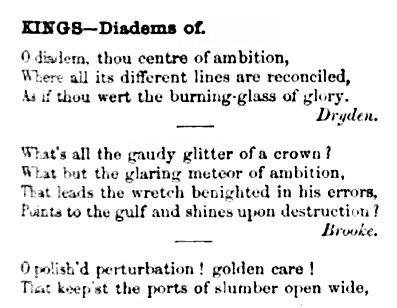
‡ NOTE: In her cento, Mrs. Deming misattributed this line to John Dryden. In researching it, I've found that in Many Thoughts of Many Minds: Being a Treasury of Reference consisting of Selections from the Writings of the Most Celebrated Authors, compiled and analytically arranged by Henry Southgate, third edition, 1862, in the section for "KINGS—Diadems of," the line "What's all the gaudy glitter of a crown" is correctly attributed to Brooke, and immediately above that entry is Dryden's name, for a verse ending in "As if thou wert the burning-glass of glory," also correctly attributed, from Œdipus. Deming may have misread it, thereby misattributing the author. It's also possible that she found it elsewhere wrongly attributed to Dryden, but it seems likely that the Southgate quotation book was the source of the error on either account. I was a bit sad to find this mistake, as I'd thought that she pieced together her cento using full literary works and not secondhand quotations. The description above the poem in many publications read, "This is the result of a year's laborious search among the voluminous writings of thirty-eight leading poets of the past and present." Obviously, the work is still very impressive even if she used some or all quotes compiled by others, but I will admit that my heart sank just a little. —tg
Source: Google Books LINE 32 — F. QUARLES, ESTER, 1621
Who hopes t' attain the sweet Elysian Layes
To reap the harvest of his well-spent dayes,
Must passe the joylesse streames of Acheron,
The scorching waves of burning Phlegeton,
And sable billows of the Stygian Lake:
Thus sweet with sowre each mortall must partake.
What joyfull Harvester did e'r obtain
The sweet fruition of his hopefull gain,
Vntill his hardy labours first had past
The summers heat, and stormy Winters blast?
A sable night returns a shining morrow;
And dayes of joy ensue sad nights of sorrow:
The way to bliss lies not on beds of Down, ←
And he that had no Crosse, deserves no Crown:
There's but one Heav'n, one place of perfect ease,
In man it lies, to take it where he please,
Above, or here below: and few men doe
Injoy the one, and taste the other too:
Sweating and constant labour wins the Goale
Of rest; Afflictions clarifie the soule,
And like hard Masters, give more hard directions,
Tut'ring the nonage of uncurb'd affections:
Wisdome (the Antidote of sad despaire)
Makes sharp Afflictions seem not as they are,
Through patient sufferance; and doth apprehend,
Not as they seeming are, but as they end:
To beare Affliction with a bended brow,
Or stubborn heart is but to disallow
The speedy means to health; salve heales no sore,
If mis-apply'd, but makes the griefe the more;
Who sends Affliction, sends an end, and He
Best knows what's best for him, what's best for me:
'Tis not for me to carve me where I like;
Him pleases when he lift to stroke or strike:
Ile neither with, nor yet avoid Tentation,
But still expect it, and make preparation:
If he think best, my Faith shall not be tride,
Lord keep me spotlesse from presumptuous pride:
If otherwise, with triall, give me care,
By thankfull patience to prevent despaire:
Fit me to bear what e'r thou shalt assigne;
I kisse the Rod, because the Rod is thine.
How-e'r, let me not boast, nor yet repine,
With triall, or without, (Lord) make me thine.
—Francis Quarles (c.1592–1644), English poet, Hadassa: or The History of Qveene Ester: With Meditations thereupon, Diuine and Morall, 1621, quoted from "Hadassa: The Historie Of Ester," Divine Poems, 1642 [The original edition reads: "The way to Blisse lyes not on beds of Downe," "And he that had no Crosse, deserues no Crowne." —tg]
LINE 33 — R. WATKYNS, THE HOURGLASS, 1662
“Inter spemǵ metumǵ timores inter & iras
Omnem crede diem tibi diluxisse supremum.”
Our time consumes like smoke, and posts away,
Nor can we treasure up a month or day.
The sand within the transitory glass
Doth haste, and so our silent minutes pass.
Consider how the lingring hour-glass sends
Sand after sand, until the stock it spends.
Year after year we do consume away,
Until our debt to Nature we do pay.
Old age is full of grief: the life of man
(If we consider) is but like a span
Stretcht from a swollen hand: the more extent
It is by strength, the more the pains augment.
Desire not to live long, but to live well,
How long we live not years, but actions tell. ←
—Rowland Watkyns (c.1614–1664), Welsh cleric, "The Hour-glass,"Flamma sine Fumo: or, Poems without Fictions; Hereunto are annexed the Causes, Symptoms, or Signes of several Diseases with their Cures, and also the diversity of Urines, with their Causes in Poetical Measure, 1662 [Latin epigraph: Horace, Epistles —tg]
LINE 34 — R. HERRICK, HESPERIDES, 1648
* * *
AMBITION.
In man, Ambition is the common'st thing;
Each one by nature loves to be a king.
* * *
MISERIES.
Though hourely comforts from the gods we see,
No life is yet life-proofe from miserie.
* * *
MERITS MAKE THE MAN.
Our honours and our commendations be
Due to the merits, not authoritie.
* * *
VERTUE.
Each must in Vertue strive for to excell;
That man lives twice, that lives the first life well. ←
* * *
THE HAND AND TONGUE.
Two parts of us successively command;
The tongue in peace, but then in warre the hand.
* * *
THE POWER IN THE PEOPLE.
Let kings command, and doe the best they may,
The saucie subjects still will beare the sway.
* * *
NOTHING NEW.
Nothing is new; we walk where others went.
Ther's no vice now, but has his president.
* * *
TO LIVE FREELY.
Let's live in hast; use pleasures while we may;
Co'd life return, 'twod never lose a day.
* * *
ILL GOVERNMENT.
Preposterous is that government, and rude,
When kings obey the wilder multitude.
* * *
GREAT SPIRITS SUPERVIVE.
Our mortall parts may wrapt in seare-cloths lye;
Great spirits never with their bodies dye.
* * *
NONE FREE FROM FAULT.
Out of the world he must who once comes in;
No man exempted is from death or sinne.
* * *
—Robert Herrick (1591–1674), English clergyman and poet, Hesperides, or The Works both Humane & Divine of Robert Herrick, Esq., 1648, quoted from The Works of Robert Herrick, Volume First, 1823
LINE 35 — W. MASON, ON THE DEATH OF A LADY, 1760
The midnight clock has toll'd; and hark, the bell
Of Death beats slow! heard ye the note profound?
It pauses now; and now, with rising knell,
Flings to the hollow gale its sullen sound.
* * *
Early to lose; while, born on busy wing,
Ye sip the nectar of each varying bloom:
Nor fear, while basking in the beams of spring,
The wintry storm that sweeps you to the tomb.
Think of her fate! revere the heav'nly hand
That led her hence, though soon, by steps so slow;
Long at her couch Death took his patient stand,
And menac'd oft, and oft withheld the blow:
To give Reflection time, with lenient art,
Each fond delusion from her soul to steal;
Teach her from Folly peaceably to part,
And wean her from a world she lov'd so well.
Say, are ye sure his Mercy shall extend
To you so long a span? Alas, ye sigh:
Make then, while yet ye may, your God your friend, ←
And learn with equal ease to sleep or die!
* * *
Go wiser ye, that flutter Life away,
Crown with the mantling Juice the goblet high;
Weave the light dance, with festive freedom gay,
And live your moment, since the next ye die.
Yet know, vain Scepticks, know, th' Almighty mind,
Who breath'd on Man a portion of his fire,
Bad his free Soul, by earth nor time confin'd,
To Heav'n, to Immortality aspire.
Nor shall the Pile of Hope, his Mercy rear'd,
By vain Philosophy be e'er destroy'd:
Eternity, by all or wish'd or fear'd,
Shall be by all or suffer'd or enjoy'd.
—William Mason (1725–1797), English poet, "On the Death of a Lady," 1760, quoted from "Elegy III: On the Death of a Lady," Elegies, 1763
LINE 36 — A. HILL, ALZIRA, 1744
What does thy ill-taught fear mistake, for shame?
Virtue, at midnight, walks, as safe, within,
As in the conscious glare of flaming day.
She who in forms finds virtue, has no virtue.
All the shame lies, in hiding honest love.
—Honour, alien phantom, here call'd pride,
Lends but a length'ning shade, to setting virtue.
Honour's not love of innocence, but praise!
The fear of censure, not distaste of sin!
—But, I was taught in a sincerer clime,
That virtue, tho' it shines not, still, is virtue:
And heart-felt honour grows not, but within.
This my heart knows: and, knowing, bids me dare,
Shou'd Heav'n forsake the just, be bold, and save him.
* * *
—A black, presaging, sorrow swells my heart!
What could a day, like this, produce, but woe?
Oh!—thou! dark, aweful, vast, mysterious Pow'r,
Whom Christians worship, yet, not comprehend! ←
If, ignorant of thy new laws, I stray,
—Shed from thy distant heav'n, where-e'er it shines,
One ray of guardian light, to clear my way:
And teach me, first to know, then act THY WILL.
But, if my only crime is—love of Zamor,
If that offends thine eye, and claims thy anger: Pour thy due vengeance on my hopeless head;
For, I am, then, a wretch, too lost, for MERCY.
—Aaron Hill (1685–1750), English author, Alzira: or, Spanish Insult Repented, A Tragedy, Acted at the Theatre-Royal in Drury-Lane, 1744, quoted from The Dramatic Works of Aaron Hill, Esq., Volume the Second, 1760 [Act IV, Alzira speaking]
LINE 37 — R. H. DANA, THOUGHTS ON THE SOUL, 1829
It is the Soul's prerogative, its fate,
To change all outward things to its own state:
If right itself, then, all without is well;
If wrong, it makes of all around a hell.
So multiplies the Soul its joy or pain,
Gives out itself, itself takes back again.
Transformed by thee, the world hath but one face.—
Look there, my Soul! there thine own features trace!
And all through time, and down eternity,
Where'er thou goest, that face shall look on thee...
—Life in itself, it life to all things gives;
For whatsoe'er it looks on, that thing lives—
Becomes an acting being, ill or good;
And, grateful to its giver, tenders food
For the Soul's health, or, suffering change unblest,
Pours poison down to rankle in the breast:
As is the man, e'en so it bears its part,
And answers, thought to thought, and heart to heart.
Yes, man reduplicates himself. You see,
In yonder lake, reflected rock and tree.
Each leaf at rest, or quivering in the air,
Now rests, now stirs as if a breeze were there
Sweeping the crystal depths. How perfect all!
And see those slender top-boughs rise and fall;
The double strips of silvery sand unite
Above, below, each grain distinct and bright.
—Thou bird, that seek'st thy food upon that bough,
Peck not alone; that bird below, as thou,
Is busy after food, and happy, too.
—They're gone! Both, pleased, away together flew.
And see we thus sent up, rock, sand, and wood,
Life, joy, and motion from the sleepy flood?
The world, O man, is like that flood to thee:
Turn where thou wilt, thyself in all things see
Reflected back...
The rill is tuneless to his ear who feels
No harmony within; the south wind steals
As silent as unseen amongst the leaves.
Who has no inward beauty, none perceives,
Though all around is beautiful. Nay, more—
In nature's calmest hour he hears the roar
Of winds and flinging waves—puts out the light,
When high and angry passions meet in fight;
And, his own spirit into tumult hurled,
He makes a turmoil of a quiet world:
The fiends of his own bosom people air
With kindred fiends, that hunt him to despair.
Hates he his fellow-men? Why, then, he deems
'Tis hate for hate:—as he, so each one seems.
Soul! fearful is thy power, which thus transforms
All things into its likeness; heaves in storms
The strong, proud sea, or lays it down to rest,
Like the hushed infant on its mother's breast—
Which gives each outward circumstance its hue,
And shapes all others' acts and thoughts anew,
That, so, they joy, or love, or hate, impart,
As joy, love, hate, holds rule within the heart.
Then, dread thy very power; for, works it wrong,
It gives to all without a power as strong
As is its own—a power it can't recall:—
Such as thy strength, e'en so will be thy thrall.
The fiercer are thy struggles, wrath, and throes,
Thou slave of sin, the mystic chain so grows
Closer and heavier on thee. Thus, thy strength
Makes thee the weaker, verier slave, at length,
Working, at thine own forge, the chain to bind,
And wear, and fret thy restless, fevered mind.
Be warned! Thou canst not break or 'scape the power
In kindness given in thy first breathing hour:
Thou canst not slay its life: it must create;
And, good or ill, there ne'er will come a date
To its tremendous energies. The trust, ←
Thus given, guard, and to thyself be just. ←
Nor dream with life to shuffle off this coil;
It takes fresh life, starts fresh for further toil,
And on it goes, forever, ever, on,
Changing, all down its course, each thing to one
With its immortal nature. All must be,
Like thy dread self, one dread eternity...
Linked with th' Immortal, immortality
Begins e'en here. For what is time to thee,
To whose cleared sight the night is turned to day,
And that but changing life, miscalled decay?
Is it not glorious, then, from thy own heart
To pour a stream of life?—to make a part
With thy eternal spirit things that rot,—
That, looked on for a moment, are forgot,
But to thy opening vision pass to take
New forms of life, and in new beauties wake?
To thee the falling leaf but fades to bear
Its hues and odours to some fresher air...
In one eternal round they go and come;
And where they travel, there hast thou a home
For thy far-reaching thoughts.—O, Power Divine,
Has this poor worm a spirit so like Thine?
Unwrap its folds, and clear its wings to go!
Would I could quit earth, sin, and care, and wo!
Nay, rather let me use the world aright:
Thus make me ready for my upward flight.
Come, Brother, turn with me from pining thought,
And all those inward ills that sin has wrought;
Come, send abroad a love for all who live.
Canst guess what deep content, in turn, they give?
Kind wishes and good deeds will render back
More than thou e'er canst sum. Thou'lt nothing lack,
But say, "I'm full!"—Where does the stream begin?
The source of outward joy lies deep within.
—Richard Henry Dana, Sr. (1787–1879), American author, "Thoughts on the Soul," a poem delivered before the Porter Rhetorical Society, in the Theological Seminary, Andover, Massachusetts, September 22, 1829
LINE 38 — W. SHAKESPEARE, HENRY VI, PART III, 1590
Ah, who is nigh? come to me, friend or foe,
And tell me who is victor, York or Warwick?
Why ask I that? my mangled body shows,
My blood, my want of strength, my sick heart shows,
That I must yield my body to the earth
And, by my fall, the conquest to my foe.
Thus yields the cedar to the axe's edge,
Whose arms gave shelter to the princely eagle,
Under whose shade the ramping lion slept,
Whose top-branch overpeer'd Jove's spreading tree
And kept low shrubs from winter's powerful wind.
These eyes, that now are dimm'd with death's black veil,
Have been as piercing as the mid-day sun,
To search the secret treasons of the world:
The wrinkles in my brows, now fill'd with blood,
Were liken'd oft to kingly sepulchres;
For who lived king, but I could dig his grave?
And who durst smile when Warwick bent his brow?
Lo, now my glory smear'd in dust and blood!
My parks, my walks, my manors that I had,
Even now forsake me, and of all my lands
Is nothing left me but my body's length.
Why, what is pomp, rule, reign, but earth and dust?
And, live we how we can, yet die we must. ←
—William Shakespeare (1564–1616), The Third Part of King Henry VI, c.1590, quoted from William George Clark and William Aldis Wright, The Works of William Shakespeare, The Globe Edition, 1864 [Act V,Scene II, Earl of Warwick]
Sources & Acknowledgements —
Kimberly Sharp
Google Books, books.google.com
Internet Archive eBooks and Texts, archive.org
Phoenix Public Library, phoenixpubliclibrary.org
California Digital Newspaper Collection, cdnc.ucr.edu
Encyclopedia Britannica, britannica.com
The Viral Texts Project, viraltexts.org
Google Search, google.com
Google News Archive, news.google.com/newspapers
Library of Congress, loc.gov
Merriam-Webster, merriam-webster.com
HeritageQuest, ancestry.com
Find a Grave, findagrave.com
University of Michigan Library, lib.umich.edu
Modern Latin Translator, latin-translator.com
University of Oxford, The Bodleian Libraries, bodleian.ox.ac.uk
Oxford Reference, oxfordreference.com
Oxford Dictionary of National Biography, oxforddnb.com
J. E. Addison, William Mason thesis, 2011, research.manchester.ac.uk
The Dictionary of Welsh Biography, biography.wales
The Gentleman's Magazine, December 1747 and February 1779
David Nichol Smith and Edward L. McAdam, The Poems of Samuel Johnson, 1941
Nathan Drake, M.D. (1766–1836), Essays, Biographical, Critical, and Historical, Illustrative of The Rambler, Adventurer, and Idler, 1810
George Birkbeck Hill, Letters of Samuel Johnson, LL.D., 1892
Emily Lorraine de Montluzin, The Poetry of the Gentleman's Magazine, 1731–1800: An Electronic Database of Titles, Authors, and First Lines, gmpoetrydatabase.org
Robert D. Brown and Robert DeMaria, Jr., The Complete Poems of Samuel Johnson, 2024, routledge.com
James Boswell, Life of Samuel Johnson, LL.D., 1791
William Prideaux Courtney and David Nichol Smith, A Bibliography of Samuel Johnson, 1915
Thomas Gray Archive, thomasgray.org
Open Source Shakespeare, opensourceshakespeare.org
U.S. National Library of Medicine PubMed, pubmed.ncbi.nlm.nih.gov
Maine Historical Society: H. W. Longfellow, hwlongfellow.org
John Uebersax, Night Thoughts article, john-uebersax.com
Michael J. Connolly, R. H. Dana article, theimaginativeconservative.org
Bible Gateway, biblegateway.com
planted Feb 2016
·
re-tended 2024
www.quotegarden.com/blog-cento-deming.html
centos, mrs. h. a. deming, life, mosaic poems, centones, a literary curiosity, poetry, vintage literature, patchwork poem, elizabeth p. deming, biographical, biography, who is, sourced, resources, research, quotes, quotations